IPL (intense pulsed light) and BBL (broadband light) treatments are incredibly effective for sun spots, age spots, and general brown discoloration.
Here’s how it works. The device delivers broad-spectrum light that targets melanin specifically. The pigmented cells absorb this light energy, heat up, and break apart. Over the next 7-10 days, darkened spots rise to the surface and flake off like coffee grounds.
Your treatment takes about 20-30 minutes. You’ll feel warm pulses like a rubber band snap. Uncomfortable but tolerable. Right after, treated spots look darker (this is good and expected). Over the next week, they get even darker and crusty, then shed off naturally.
Most people need 2-4 treatments spaced 4-6 weeks apart for significant clearing. Some spots disappear after one session. Stubborn ones need multiple treatments.
The results are dramatic. Those brown spots that bothered you for years? Gone. Your skin looks years younger and much more even-toned.
IPL works beautifully on fair to medium skin tones. For darker skin, we use different technology (more on that below).
Medical-grade chemical peels use acids to remove pigmented skin layers and stimulate fresh skin growth without excess melanin.
Glycolic acid peels work well for mild to moderate dark spots. They exfoliate surface pigmentation and encourage even melanin distribution. Usually need a series of 4-6 peels.
TCA peels (trichloroacetic acid) penetrate deeper for more stubborn hyperpigmentation. They’re more aggressive with more peeling (5-7 days), but results are impressive for resistant spots.
Jessner’s peels and combination peels address both pigmentation and texture. Good for people with dark spots plus rough skin or mild scarring.
The process is straightforward. We apply the acid solution to your skin. You feel burning that peaks then subsides. After the appropriate time, we neutralize it (or it self-neutralizes). Your skin looks red immediately, then over the next few days starts peeling visibly.
As dead, pigmented skin sheds off, fresh even-toned skin emerges. Each peel progressively lightens dark spots.
Chemical peels work on all skin tones but require careful selection and technique for darker skin to avoid causing more pigmentation.

Q-switched lasers (Nd:YAG and Alexandrite) deliver ultra-short pulses that shatter melanin pigment without damaging surrounding skin.
These lasers excel at removing individual stubborn spots that won’t respond to IPL or peels. We can target specific areas with precision.
Treatment feels like hot pinpricks. Each spot takes just seconds. Treated areas immediately turn white (frosting effect), then darken over the next week before flaking off.
Q-switched lasers are particularly good for darker skin tones because we can use wavelengths (1064nm) that bypass surface melanin and target deeper pigment safely.
Most spots need 1-3 treatments for complete removal. Deep or stubborn pigmentation might need more.
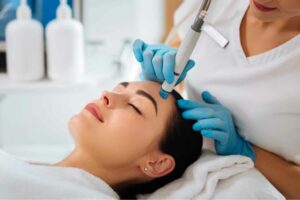
Professional dark spot treatment isn’t just in-office procedures. Medical-grade skincare is critical for both preparing your skin and maintaining results.
Hydroquinone is the gold standard lightening agent. It’s prescription-strength (4% or higher) and works by inhibiting melanin production. You apply it nightly to dark spots. Over weeks, pigmentation gradually fades.
Hydroquinone works, but you can’t use it forever. We cycle you on and off to maintain results without side effects.
Tretinoin (Retin-A) accelerates cell turnover and pushes pigmented cells to the surface faster. It also helps other lightening ingredients penetrate deeper.
Kojic acid, azelaic acid, and vitamin C are powerful lightening agents we combine in customized regimens.
Tranexamic acid (oral or topical) is particularly effective for melasma.
We often start you on prescription skincare 2-4 weeks before laser or peel treatments. This “primes” your skin for better, more even results.
After treatment, you continue medical-grade products to maintain your clear complexion long-term.
Melasma is tricky. Those brown patches on your cheeks, forehead, and upper lip are hormonally driven and incredibly persistent.
Standard dark spot treatments can help melasma but often don’t eliminate it completely. It also tends to come back, especially with sun exposure or hormonal changes.
Our melasma protocol combines multiple approaches:
Triple combination cream (hydroquinone, tretinoin, and a steroid) to aggressively lighten pigmentation.
Gentle chemical peels (we use lower strengths to avoid inflammation that can worsen melasma).
Careful laser treatments (we might avoid lasers entirely for severe melasma because they can make it worse).
Oral tranexamic acid for resistant cases.
Religious sun protection (non-negotiable).
Melasma management requires patience. It takes months to see significant improvement, and you’ll need ongoing maintenance to keep it under control.
If you have melasma, come in expecting long-term management, not a quick fix. We’ll be honest about what’s realistic.
Skin tone matters enormously with dark spot treatment. Using the wrong treatment on dark skin can cause permanent light patches or make pigmentation worse.
We assess every patient using the Fitzpatrick scale (I through VI). This determines which treatments are safe for you.
Fair to medium skin (Fitzpatrick I-IV) can use IPL, most lasers, and aggressive chemical peels safely.
Olive to dark skin (Fitzpatrick IV-V) needs careful laser selection and conservative peel strengths. We use specific wavelengths and lower energy settings to avoid triggering more pigmentation.
Very dark skin (Fitzpatrick VI) often can’t safely use IPL at all. We rely on Q-switched Nd:YAG laser (1064nm wavelength), gentle peels, and aggressive prescription skincare instead.
We’ve treated hundreds of patients with dark skin throughout Hollywood, Hallandale Beach, Pembroke Pines, and Fort Lauderdale. Experience with diverse skin tones is critical. Many providers won’t treat dark skin because they don’t know how. We do.
If you have darker skin and you’ve been told dark spot treatment isn’t safe for you, come get a second opinion.
Here’s what actually happens when you get dark spot treatment.
Consultation: We examine your spots, identify the type (sun damage, melasma, PIH), assess your skin tone, discuss your goals, and create a customized plan.
Pre-treatment: You start prescription skincare to prepare your skin (2-4 weeks). You avoid sun completely and wear SPF 50 daily.
Treatment sessions: Depending on what you’re getting (IPL, peel, laser), sessions take 20-60 minutes. You might need 2-6 treatments spaced 4-6 weeks apart.
Post-treatment: Spots darken for 3-7 days, then start flaking off. You look progressively better each week. You continue prescription skincare and sun protection religiously.
Maintenance: Once spots are clear, you do occasional touch-up treatments and maintain medical-grade skincare to prevent recurrence.
Results timeline: Initial fading happens within 2-3 weeks. Significant clearing takes 2-4 months. Complete clearing of stubborn spots can take 6-12 months.
This isn’t instant. Dark spots took years to develop. Removing them safely takes time.
Here’s the hard truth. If you don’t protect your skin from sun, dark spots will come back. All the treatments in the world won’t help if you’re constantly creating new sun damage.
Living in Hollywood makes this challenging. You’re at the beach, by the pool, outside year-round. But sun protection is absolutely critical for both treating existing spots and preventing new ones.
SPF 50 or higher every single day. Rain or shine, indoor or outdoor.
Reapply every 2 hours if you’re outside. Most people skip this and wonder why spots return.
Physical sunscreen (zinc oxide, titanium dioxide) is better than chemical sunscreens for dark spot prevention.
Wear hats and seek shade. Sunscreen alone isn’t enough.
Avoid peak sun hours (10am-4pm) when possible.
We’ll be blunt during consultation. If you can’t commit to sun protection, don’t waste money on dark spot treatment. Spots will return within months.
Most of our patients find that once they see how much clearer their skin looks, sun protection becomes second nature. You don’t want to undo your investment.
Let’s set honest expectations. Dark spot treatment dramatically improves your skin, but results vary based on spot type, depth, and your skin tone.
Sun spots and age spots: 70-90% clearing with a treatment series. Some spots disappear completely. Stubborn ones fade significantly.
Post-inflammatory hyperpigmentation: 60-80% improvement. Recent marks (under 6 months old) clear faster than old ones.
Melasma: 40-70% improvement, but it’s stubborn and often comes back without ongoing management. This is the hardest type to treat.
Freckles: 80-95% fading with IPL or laser. They respond beautifully.
Deep pigmentation in dark skin: Slower improvement (50-70%) requiring more sessions, but significant clearing is achievable with proper protocols.
Complete, permanent removal of every single dark spot? That’s not realistic. But dramatic clearing that makes you feel confident again? Absolutely achievable.
We’ll show you before-and-after photos during consultation so you see realistic results for concerns similar to yours.
Most patients get best results from combining approaches strategically.
For example, we might start with prescription skincare for 4 weeks, then do a series of IPL treatments for the bulk of pigmentation, follow with chemical peels for remaining stubborn areas, and maintain with ongoing medical-grade products.
Or for melasma, we use triple cream plus gentle peels plus oral tranexamic acid plus strict sun protection. Melasma needs multi-modal treatment.
The key is customizing your protocol based on your specific pigmentation type, skin tone, and lifestyle.
Dark spot treatment requires medical expertise, especially for darker skin tones. The provider matters enormously for both safety and results.
We’re a licensed medical spa with a board-certified medical director. Dark spot treatment is medical care, not a cosmetic service.
We have multiple FDA-cleared technologies. IPL/BBL, Q-switched lasers, medical-grade chemical peels. This lets us match the right treatment to your specific spots and skin tone instead of forcing everyone into whatever device we happen to own.
Our specialists have extensive experience treating hyperpigmentation across all skin tones. We understand melanin regulation, safe laser settings for dark skin, and how to avoid making pigmentation worse.
We’re realistic about what’s achievable. If your melasma is severe and you’re not ready to commit to long-term management, we’ll tell you that upfront. Trust matters more than making a quick sale.
We’re located in Hollywood, easily accessible from Hallandale Beach, Pembroke Pines, Fort Lauderdale, Aventura, Dania Beach, and throughout Broward County. Close to Hollywood Beach Broadwalk and Downtown Hollywood.
Pricing varies based on treatment type, number of spots, and sessions needed.
IPL photofacial sessions typically cost a few hundred dollars each. Most people need 2-4 treatments.
Chemical peels range based on strength and type. Lighter peels cost less than deeper TCA peels.
Q-switched laser spot removal is often priced per spot or by area size.
Prescription skincare adds ongoing monthly costs but is critical for results.
Many patients spend a few thousand dollars total for a comprehensive treatment series plus maintenance skincare.
Here’s how to think about value. You’ve probably spent years buying products that don’t work. Dark spot treatment actually fixes the problem instead of temporarily covering it.
We offer package pricing for multiple sessions, which reduces per-treatment cost. We also work with CareCredit for financing.
During your free consultation, we’ll examine your spots and give you exact pricing for your customized plan. No surprises, no pressure.
Let’s be real about Hollywood life. Year-round sun exposure means pigmentation is an ongoing battle. Even with perfect sun protection, damage from years ago keeps showing up.
That’s not your fault. It’s geography.
Dark spot treatment lets you reset your complexion. Clear away accumulated sun damage. Start fresh with even-toned skin.
Then you maintain with good sun habits and occasional touch-up treatments. Most patients do intensive treatment initially, then come back once or twice a year for maintenance.
This approach keeps South Florida sun damage under control long-term without requiring you to hide indoors forever.
