Does Insurance Cover Tattoo Removal? No — Here's What You Should Budget Instead
No. Cosmetic laser tattoo removal is elective, not medically necessary, and health insurance is built around covering the second category, not the first. A tattoo you regret doesn’t meet the bar insurers use — it’s not a disease, it’s not an injury, it’s not a threat to how your body functions. So the claim never gets past the first question an insurer asks, which is whether treating it is medically required. It isn’t, and that’s not a loophole or a gray area — it’s the whole reason the answer is no.
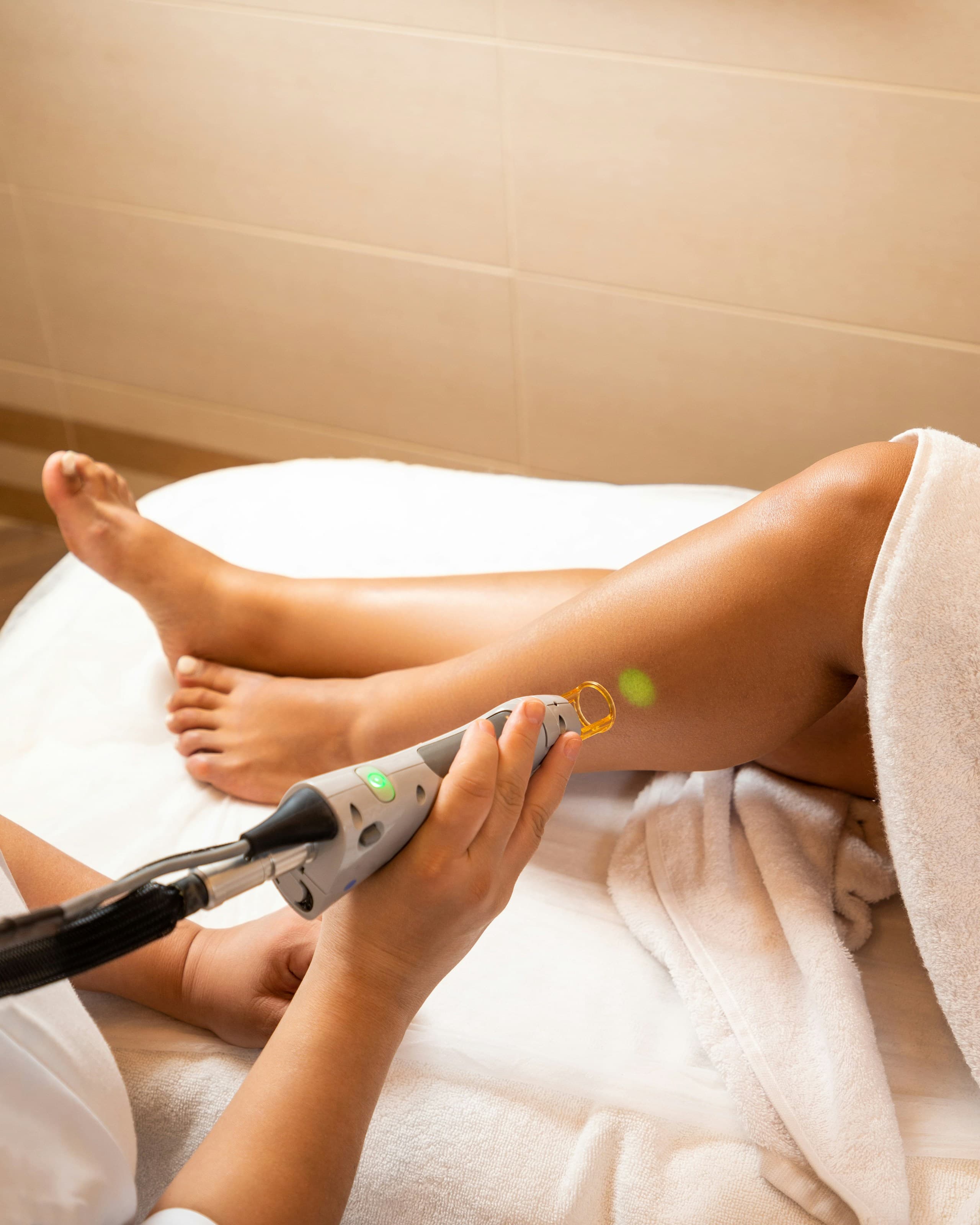
The same logic applies to permanent makeup removal. Removing microblading, a lip blush, or eyeliner tattooing is $399 per session at our spa, and insurers treat it exactly the way they treat body tattoo removal — as an elective cosmetic choice. It doesn’t matter that the tattoo is on your brow instead of your ankle. The category is what determines coverage, not the location.
Why you’re right to even ask
It’s not a naive question. Insurance routinely covers mole removal and cyst removal when a doctor documents medical necessity — a mole that’s changed shape and needs a biopsy, a cyst that’s inflamed or infected. People see “removal” covered in one context and reasonably wonder if the same logic extends to a tattoo they want gone.
It doesn’t, because the difference isn’t the word “removal” — it’s medical necessity versus elective cosmetic choice. A suspicious mole is a potential health risk that a doctor needs to evaluate or excise. A tattoo, no matter how much you regret it, isn’t a health risk. It’s a decision you made that you’d now like to unmake. Insurance pays to protect your health. It doesn’t pay to undo decisions.
What you’re actually budgeting for, size by size
Since insurance is off the table, the real question is what you’re paying out of pocket, and that starts with knowing where your tattoo falls on the size scale. Our per-session pricing runs like this:
- Extra Small (under 1×1 inch): $199
- Small (palm-sized): $249
- Medium (hand-sized): $299
- Large: $399
- Half Sleeve: $499
- Full Sleeve: $649
- Permanent Makeup Removal: $399
That’s the number that shows up on the price list, and it’s accurate as far as it goes. But a single session price is not what tattoo removal costs. It’s what one visit costs. Nobody clears a tattoo in one visit.
The number that actually matters isn’t the per-session price
Here’s the actual math, and it’s the part every price list conveniently leaves off. With the Candela PicoWay, most tattoos take 5 to 12 sessions, spaced 6 to 8 weeks apart. So take a medium tattoo — hand-sized, $299 a session. If it clears in a realistic 8-session course, that’s $299 × 8 = $2,392. Not $299. $2,392.
That’s not a bait-and-switch — it’s just how laser tattoo removal works. Each pulse breaks down a layer of ink, your body clears it over several weeks, and you come back for the next layer. Nobody’s skin absorbs a full tattoo’s worth of ink breakdown in one sitting no matter how strong the laser is.
What determines whether you land at 5 sessions or 12 isn’t the size category alone — it’s ink color, ink age, and skin tone. A faded, decade-old black tattoo on fair skin can clear in fewer visits than a dense, recent tattoo with green or blue ink, because certain colors absorb laser wavelengths less efficiently and need more passes to break down. This is why we do a real assessment before quoting a session count instead of promising a number off a size chart. Anyone who tells you exactly how many sessions your tattoo needs before looking at it is guessing.
Why the laser you choose changes that total
This is where advertised price gets misleading in the other direction. You’ll find tattoo removal priced lower per session elsewhere, usually on older Q-switched lasers. The Candela PicoWay we use fires three wavelengths — 532nm, 785nm, 1064nm — which covers colors that older single- or dual-wavelength lasers struggle with, including blues, greens, and pastels.
An older laser might save you $50 to $100 a session on paper. But if it takes more total sessions to break down the same ink — because it’s less effective on certain colors and has to work harder, pass after pass, to get the same result — you can end up spending more overall while taking longer to get there. Fewer wasted sessions on stubborn colors is what actually controls the total, not the sticker price on session one. We’d rather you compare the real total than the advertised one.
How people actually pay for it without insurance
Since this comes out of pocket, we offer financing through Affirm and Klarna so you can spread the total cost across the months your sessions are already spaced over instead of paying the full course upfront. We also accept Visa and Mastercard. No upsells, no “join our unlimited plan” pitch — just the per-session and package pricing, plus a way to finance it if paying session by session works better for your budget.
What the result actually looks like
Budget honestly, and that means being honest about the outcome too. Results vary by ink color, ink age, and skin tone — a black tattoo on fair skin fades differently than a colorful tattoo with green or blue ink on deeper skin. Removal is a fading and reduction process across multiple sessions. It is not a single visit that erases the tattoo completely. Some tattoos fade to the point of being nearly invisible. Others fade significantly but leave a faint shadow, depending on the ink and how it was applied. We tell people this upfront because budgeting toward a guaranteed complete erase, then not getting one, is worse than knowing the real range going in.
If you have deeper skin — this still applies to you
If you’ve been told your skin tone limits your options, or that you’ll need dramatically more sessions than someone with lighter skin, that’s not automatically true with the right device. The Candela PicoWay is safe across Fitzpatrick I through VI, meaning it’s built to work on very fair skin and very dark skin alike without the tradeoffs older lasers forced on darker skin tones.
What actually determines your session count and candidacy is your specific tattoo and skin — not a general rule about skin tone. That’s why we do a free consultation and Fitzpatrick skin-type assessment before your first session. It’s where we look at your ink, your skin, and give you a real session estimate instead of a size-chart guess.
Location
Manhattan Laser Spa — Sunny Isles Beach, FL