Tattoo Removal in Fort Lauderdale, FL

Got a tattoo you regret? You’re not alone. About one in four people with tattoos eventually wants them removed.

Maybe it’s your ex’s name. Maybe it’s a design that doesn’t fit who you are anymore. Or maybe you just want a clean slate for a cover-up piece.

Whatever your reason, laser tattoo removal at Manhattan Laser Spa can help. We use medical-grade laser technology to safely fade or completely remove unwanted ink, treating all colors and skin types at our Fort Lauderdale location.

How Does Laser Tattoo Removal Work?

Let’s break down what actually happens during treatment.

The laser sends ultra-short pulses of high-energy light into your skin. These pulses target the ink particles in your tattoo. Different wavelengths target different colors. Black and dark blue respond to one wavelength, while reds, oranges, and yellows need another.

When the laser energy hits the ink, it shatters those particles into tiny fragments. Think of it like breaking a rock into pebbles, then into sand. The smaller the pieces, the easier your body can get rid of them.

Your lymphatic system (part of your immune system) then naturally carries away these microscopic ink particles over the following weeks and months. This is why you see gradual fading between sessions rather than instant results.

Here’s the important part: this process doesn’t harm your skin. The laser specifically targets the ink pigment while leaving surrounding tissue intact. That’s what makes modern laser removal so much safer than older methods like dermabrasion or surgical excision.

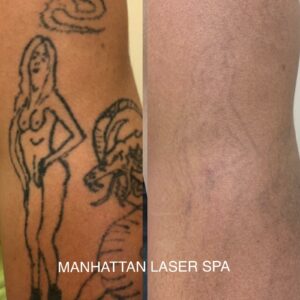
Laser tattoo Removal afterbefore manhattan laser spa

What Technology Do We Use?

We use advanced Q-switched and picosecond laser systems at Manhattan Laser Spa. These are the current gold standards for tattoo removal.

Q-Switched Lasers deliver energy in nanoseconds (billionths of a second). They’ve been the workhorse of tattoo removal for years and work extremely well on most tattoos.

Picosecond Lasers (like PicoWay and PicoSure) are newer technology that delivers energy even faster, in picoseconds (trillionths of a second). This ultra-fast delivery shatters ink into smaller particles, which means your body can clear them faster. Generally this means fewer treatments and less discomfort.

We have multiple wavelengths available: 1064nm for black and dark ink, 532nm for red and warm colors, and 755nm for stubborn greens and blues.

The right laser depends on your specific tattoo. During your consultation, we’ll assess your ink colors, skin type, and create a treatment plan that works best for your situation.

What Can We Remove?

Pretty much any tattoo. Size doesn’t matter. We’ve removed everything from tiny finger tattoos to full sleeves.

Types of tattoos we treat:

  • Professional tattoos (from shops)
  • Amateur or homemade tattoos
  • Old, faded tattoos
  • Fresh tattoos (though older ones are often easier)
  • Cover-up tattoos (multiple layers of ink)
  • Black and gray work
  • Full-color tattoos
  • Cosmetic tattoos (eyebrows, eyeliner, lip liner)
  • Permanent makeup
  • Traumatic tattoos (accidental ink from injuries)

Common removal reasons:

  • Ex-partner’s name (we do a lot of these)
  • Career requirements
  • Fading before a cover-up
  • Poorly done tattoos
  • Tattoos that don’t match who you are now
  • Visible tattoos that affect professional appearance
  • Gang-related tattoos
  • Just not feeling it anymore

Living in Fort Lauderdale means visible skin year-round. If you’re tired of covering up at Fort Lauderdale Beach or worrying about what people think, we get it.
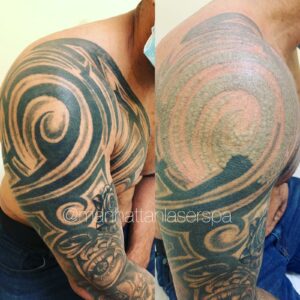
 

Laser tattoo Removal before after manhattan laser spa

How Many Sessions Will You Need?

This is always the first question, and the honest answer is: it depends.

Most tattoos need 6-12 sessions for significant fading or removal. Some need more. A few lucky people see great results in fewer sessions.

Here’s what affects the number of treatments:

Ink color: Black is easiest. It absorbs all laser wavelengths. Dark blue, brown, and red respond well too. Green, yellow, light blue, and purple are trickier and need more sessions. White and pastel colors are the hardest to remove.

Tattoo age: Older tattoos are often easier because they’ve already started fading naturally. Fresh tattoos have dense, deep ink that takes longer.

Professional vs amateur: Professional tattoos go deeper and use more ink, so they need more sessions. Stick-and-poke or homemade tattoos are shallower and often respond faster.

Location on your body: Areas with good blood flow (face, neck, chest) clear faster because your lymphatic system works more efficiently there. Hands, feet, and ankles have poor circulation and take longer. Legs are somewhere in the middle.

Ink density: Solid black work or heavy shading takes longer than fine line work or watercolor-style tattoos.

Your skin type: Fair skin generally shows results faster. Darker skin needs more conservative settings (to avoid pigmentation changes), which can extend treatment time.

Cover-up layers: If your tattoo is covering another tattoo, you’re dealing with multiple layers of ink. That takes longer.

Your immune system: Healthy immune systems clear ink faster. Smoking, poor diet, or certain health conditions slow the process.

Sessions are spaced 6-8 weeks apart minimum. Your skin needs time to heal, and your body needs time to flush out the fragmented ink. Some providers recommend 8-12 weeks between sessions for better results.

Does It Hurt?

Let’s be real. Yes, it hurts. But it’s manageable.

Most people describe the sensation as a hot rubber band snapping against your skin repeatedly. Some say it feels like hot grease splattering. It’s quick and sharp, but it’s over relatively fast.

Honestly? Getting the tattoo usually hurts worse than removing it. But everyone’s pain tolerance is different.

What helps with the discomfort:

We apply numbing cream 30-45 minutes before your session. This takes the edge off significantly.

We use cooling systems during treatment. Cold air blows on your skin between laser pulses, which helps numb the area and makes it more comfortable.

For larger tattoos or sensitive areas, we can prescribe stronger topical anesthetics or even injectable lidocaine.

Treatment time is relatively short. A small tattoo might only take 5-10 minutes. Even a large piece rarely takes more than 30-45 minutes.

Pain levels by location:

  • Most painful: ribs, feet, hands, inner arm, spine, neck
  • Moderate: outer arm, shoulder, calf, thigh
  • More tolerable: outer forearm, back, chest

The first session usually feels worst because there’s the most ink to target. Each subsequent session typically hurts less as the tattoo fades.

Clear Brilliant® Laser manhattan laser spa Midtown Newyork

What to Expect During Treatment?

Here’s what actually happens when you come in for a session.

Before Treatment:

We’ll clean the area thoroughly. Then we apply numbing cream and let it sit for 30-45 minutes. You can hang out in the waiting room during this time.

You’ll put on protective eyewear (laser light can damage your eyes, so this is non-negotiable).

During Treatment:

We’ll position the laser handpiece against your skin and start delivering pulses. You’ll hear clicking sounds and see flashes of light.

Your skin will turn white or “frost” immediately after each pulse. This is normal and temporary. It’s the gas bubbles forming as the ink particles shatter.

Some people see pinpoint bleeding. Also normal.

You might smell something burning. That’s just the interaction between laser and ink. It’s not your skin burning.

We work section by section, making sure to cover the entire tattoo evenly.

After Treatment:

The treated area will be red, swollen, and tender, like a bad sunburn. We’ll apply antibiotic ointment and bandage it.

You can go right back to normal activities, but avoid intense exercise for 24 hours.

Recovery and Aftercare

Taking care of your skin after each session is critical for good results and avoiding complications.

First 24-48 hours:

  • Keep the area covered with antibiotic ointment (like Aquaphor or the ointment we provide)
  • Ice packs help with swelling and discomfort
  • Take over-the-counter pain relievers if needed
  • Don’t pick at blisters if they form (they’re normal and will heal)
  • Keep the area clean but gentle

First week:

  • Blisters may form in days 1-3. This is your body’s normal response. Don’t pop them. Let them heal on their own.
  • Scabs will form as blisters heal. Don’t pick at them.
  • Wash gently with mild soap and pat dry
  • Keep applying ointment until scabs fall off naturally
  • Avoid swimming pools, hot tubs, and ocean water (infection risk)
  • No saunas or hot showers
  • Skip the gym if you’ll be sweating heavily

First 6-8 weeks:

  • Once healed, apply SPF 30+ sunscreen religiously. Sun exposure can cause pigmentation changes.
  • Don’t tan (natural sun or tanning beds)
  • You’ll see the tattoo continue to fade over these weeks as your body clears the ink
  • Stay hydrated and maintain a healthy lifestyle to support your immune system

Between sessions:

  • The tattoo will look lighter but won’t disappear completely between treatments
  • You might see uneven fading at first. This is normal and evens out with more sessions.
  • If you develop any unusual symptoms (severe pain, spreading redness, oozing), call us immediately

laser tattoo removal nyc Quick Fix

Realistic Expectations: What Complete Removal Really Means

Let’s talk honestly about results because there’s a lot of misinformation out there.

Complete removal isn’t always possible. Most people see 70-95% fading, which means the tattoo becomes barely visible or invisible from a conversational distance. But if you look closely in good lighting, you might see a faint “ghost” or shadow where the tattoo was.

Complete 100% clearance with no trace? It happens, but it’s not guaranteed. Factors like ink quality, colors used, and how deep the ink was placed all affect this.

You’re more likely to get complete clearance if:

  • Your tattoo is mostly black or dark blue
  • It’s an older, faded tattoo
  • It’s an amateur/homemade tattoo (shallower ink)
  • You have fair skin
  • You’re healthy and don’t smoke

Complete removal is less likely with:

  • Bright colors (green, yellow, light blue)
  • Professional tattoos with dense ink
  • Multiple cover-up layers
  • Darker skin tones (we need to use more conservative settings)
  • Tattoos on hands, feet, or ankles

Some people do need 15-20 sessions for particularly stubborn tattoos. We’ll be upfront about this during your consultation.

Scarring and texture changes are possible but rare with proper treatment. If your tattoo was already scarred or raised, that texture will remain after the ink is gone. The laser removes ink, not scar tissue.

Pigmentation changes can happen, especially with darker skin. Your treated area might be lighter (hypopigmentation) or darker (hyperpigmentation) than surrounding skin. This usually fades over time but isn’t always permanent.

Preparing a Tattoo for Cover-Up

Not interested in complete removal? Just want to lighten a tattoo so a cover-up artist has a cleaner canvas to work with?

This is actually one of the best uses for laser removal. A few sessions can significantly fade an old tattoo, giving your artist more flexibility with designs and colors.

Most tattoo artists recommend getting a tattoo at least 50-70% faded before attempting a cover-up. This opens up way more design options.

Dark, solid tattoos are especially difficult to cover. Lightening them first makes the artist’s job infinitely easier and results in a better-looking cover-up.

We work with several talented tattoo artists in the Fort Lauderdale area. If you need a recommendation after we’ve faded your tattoo, just ask.

Cost of Tattoo Removal in Fort Lauderdale

Pricing varies based on several factors: size, ink colors, location on body, and number of sessions needed.

General pricing ranges:

Small tattoos (under 2 square inches): $75-150 per session

Medium tattoos (2-6 square inches): $150-300 per session

Large tattoos (6+ square inches): $300-600+ per session

Most places (including us) offer package deals that bring the per-session cost down. A package of 6-8 treatments typically saves you 15-25% compared to paying per session.

During your free consultation, we’ll measure your tattoo, assess the complexity, and give you an exact quote along with an estimated number of sessions.

Yes, tattoo removal is expensive. But think about it this way: you’re paying to undo something permanent. The technology required is sophisticated and expensive, and it takes medical expertise to do it safely.

Why Choose Manhattan Laser Spa for Tattoo Removal in Fort Lauderdale?

Here’s what makes us different:

Medical Expertise: All treatments are performed under physician supervision. This is a medical procedure, not a spa treatment. You want trained medical professionals handling this.

Advanced Technology: We use both Q-switched and picosecond laser systems with multiple wavelengths. This means we can treat all ink colors and all skin types safely and effectively.

Experienced Staff: Our technicians are trained and certified in laser safety and tattoo removal protocols. They know how to adjust settings for your specific needs.

Honest Assessments: We won’t promise complete removal if it’s unlikely. We’ll give you realistic expectations based on your specific tattoo during your free consultation.

All Skin Types Welcome: We safely treat Fitzpatrick skin types I through VI (fair skin to very dark skin). Many older lasers can’t do this safely.

Pain Management Options: We offer multiple options to keep you comfortable, from numbing cream to cooling systems to prescription numbing agents for larger pieces.

Flexible Scheduling: We know you’re busy. We work around your schedule and space treatments appropriately for best results.

Whether you’re coming from Las Olas, Victoria Park, Coral Ridge, or anywhere else in Broward County, we’re here to help you move on from unwanted ink.

Frequently Asked Questions?

We can remove all colors, but some are harder than others. Black and dark blue are easiest because they absorb all laser wavelengths. Red, orange, and purple respond well too.

Green, yellow, light blue, and white are the most challenging. They need specific wavelengths and usually require more sessions. Our multi-wavelength laser systems can target these stubborn colors, but you’ll need patience.

Neon and fluorescent inks can be especially tricky because they’re formulated differently than traditional tattoo ink.

During your consultation, we’ll look at your specific ink colors and give you an honest assessment of how well they’ll respond to treatment.

Yes, but it requires expertise and the right equipment. Older laser technology wasn’t safe for darker skin tones because it couldn’t differentiate between skin melanin and ink pigment. This caused burns and permanent pigmentation changes.

Modern Q-switched Nd:YAG lasers (1064nm wavelength) are specifically designed for darker skin. They penetrate deeply while bypassing skin pigment to target the ink.

We need to use more conservative energy settings and might need a few extra sessions, but we can safely treat all Fitzpatrick skin types, including very dark skin.

The key is having an experienced provider who understands how to adjust laser parameters for darker skin. We’ve successfully treated all skin tones at our Fort Lauderdale location.

Maybe. Honestly, it depends on too many factors to guarantee complete 100% clearance.

Most people see significant fading where the tattoo becomes barely visible or only noticeable in certain lighting. This is usually good enough for most purposes (professional appearance, personal satisfaction, preparing for a cover-up).

Complete clearance is most likely with black or dark blue tattoos, amateur tattoos, and older faded pieces. It’s less likely with professional multi-color work, especially pieces with greens, yellows, or light blues.

A faint ghost or shadow often remains even after extensive treatment. This is normal and expected.

We’ll assess your specific tattoo during consultation and give you realistic expectations about what’s achievable.

Plan on 12-24 months minimum for complete removal. Some tattoos take longer.

You need 6-12+ sessions on average, spaced 6-8 weeks apart. Do the math: 8 sessions at 8 weeks apart equals 56 weeks (more than a year).

Why so long? Your skin needs time to heal between sessions. More importantly, your body needs time to clear the fragmented ink through your lymphatic system. Rushing treatments too close together doesn’t speed up results and can damage your skin.

Think of this as a marathon, not a sprint. People who try to rush the process by spacing treatments too close together often end up with worse results and more complications.

Most people say getting the tattoo hurt worse, but everyone’s different.

Tattoo machines drag needles through your skin repeatedly for hours. Laser removal delivers sharp, hot pulses but only lasts 5-30 minutes depending on size.

The sensation is different. Tattooing is a dragging, burning, scratching feeling. Laser removal feels like hot rubber bands snapping or hot grease splattering.

With numbing cream and cooling systems, most people tolerate it fine. The anticipation is often worse than the actual treatment.

Some areas hurt more than others. Ribs, feet, hands, inner arms, and anywhere close to bone are more sensitive.

We recommend waiting until you’re done breastfeeding. Here’s why:

There’s no solid research showing laser tattoo removal harms pregnancy or affects breast milk, but there’s also no research proving it’s completely safe. The fragmented ink particles travel through your lymphatic system and are filtered out by your liver and kidneys. We don’t know if any particles could potentially reach a developing baby or appear in breast milk.

Because of this uncertainty, most medical providers (including us) take the cautious approach and suggest waiting.

Your tattoo has been there this long. It can wait another year or so. Your peace of mind and your baby’s safety are worth it.

The laser removes ink, not scar tissue. If your tattoo was done too deeply (blowout), is already scarred, or has raised areas, that texture will remain after the ink is gone.

In some cases, the laser treatment might actually improve texture slightly by stimulating collagen remodeling, but don’t count on it.

If you have significant scarring or textural issues, we can discuss realistic expectations during your consultation. Sometimes partial removal or fading for a cover-up makes more sense than trying for complete removal.

Ready to Say Goodbye to Your Tattoo?

You don’t have to live with ink you regret. Whether you want complete removal or just want to fade a tattoo for a cover-up, we can help.

Manhattan Laser Spa offers safe, effective laser tattoo removal using advanced technology and medical expertise. We treat all ink colors and all skin types at our Fort Lauderdale location.

Schedule your free consultation today. We’ll assess your tattoo, answer all your questions, and give you an honest opinion about what’s possible.

Call us or fill out our online form to book your appointment. Your fresh start is waiting.

logo white manhattan laser spa

Ready To Schedule Your Treatment?

Call Now Button