Can Laser Tattoo Removal Actually Erase a Tattoo — Or Just Fade It?
No, and any clinic that promises complete removal before they’ve looked at your tattoo is telling you what you want to hear, not what’s true. The honest answer is that outcomes fall somewhere on a spectrum — from significant fading to near-complete clearing — and where a specific tattoo lands depends on identifiable factors: ink color, ink density, how old the tattoo is, whether it’s a cover-up or layered piece, and your skin tone. Two tattoos that look similar in a photo can respond completely differently once the laser hits them. That’s not a hedge. That’s the reality of a treatment that works by breaking pigment into pieces small enough for your body to clear out on its own.
Why PicoWay clears more than older lasers — but still isn’t magic
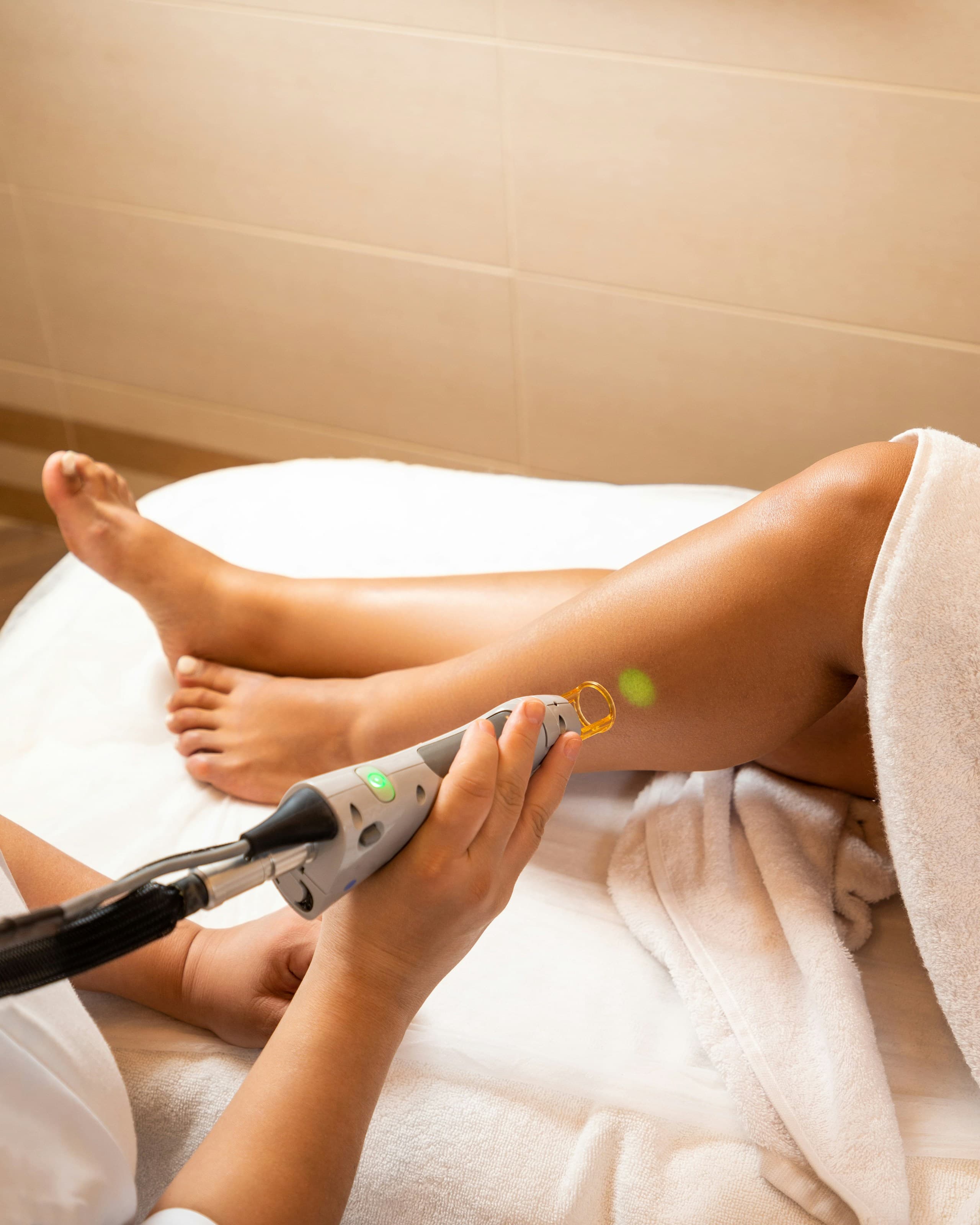
We use the Candela PicoWay, which fires picosecond pulses — pulses measured in trillionths of a second. What that speed buys you is a mechanism shift: instead of relying mainly on heat to break down the ink, a picosecond pulse hits the pigment fast enough to create a pressure wave that shatters it mechanically. Clients often describe the sensation as a rubber-band snap against the skin during treatment — quick, sharp, and over almost as soon as it starts.
Older Q-switched lasers work on a longer pulse duration and lean more on heat to break up pigment. Heat is less precise. It’s more likely to affect the surrounding skin, and it tends to need more sessions to get the same fragmentation picosecond pulses achieve in fewer passes. That’s the real advantage of PicoWay — not that it removes tattoos “better” in some vague sense, but that shattering ink with a pressure wave instead of cooking it with heat changes the odds in your favor. It does not change them to certainty.
Three wavelengths, three ink problems
Here’s the part most clinics skip because it’s easier to just say “we have a laser”: ink color determines which wavelength of light actually absorbs into it, and no single wavelength handles every color well.
The PicoWay we use fires three wavelengths — 532nm, 785nm, and 1064nm — specifically because different ink colors respond to different parts of that range. That combination is what lets us cover the full spectrum of ink colors, including blues, greens, and pastels, which is exactly the range that gives older, single-wavelength lasers the most trouble. A laser built around one wavelength might do fine on black ink and struggle badly on a teal or a light green, because that color simply doesn’t absorb that wavelength well. It’s not that the operator is doing something wrong — it’s that the light and the pigment aren’t matched.
Across all three wavelengths, PicoWay is built to be used safely on Fitzpatrick I through VI — meaning the wavelength selection isn’t just about ink color, it’s also about picking the right wavelength for a given skin tone so we’re not putting more energy into the surrounding skin than it can safely absorb.
What might fade instead of fully disappear
We’d rather tell you this before you book six sessions than after. Certain tattoos are genuinely harder cases, and “harder” sometimes means fade significantly rather than disappear completely.
Cover-ups and heavily layered pieces are one of those cases — when a tattoo was inked over an older one, you’re not removing one layer of pigment, you’re removing several stacked on top of each other, and that additional density slows things down. Certain greens are also among the hardest colors we treat, for the same wavelength-absorption reason described above — some green pigments just don’t take up light as efficiently as black or red does, no matter which laser is doing the work. And very old amateur tattoos, the kind done with a single needle and heavy hand rather than a machine, often carry denser pigment packed closer to the surface, which can also make full clearing harder than it looks.
None of this means the treatment “didn’t work.” It means the honest expectation for that specific tattoo was fade, not fully gone — and we’d rather say that on day one than let a client find out after paying for a full session package.
How many sessions, honestly
Typically 5 to 12 sessions, spaced 6 to 8 weeks apart so your body has time to clear the fragmented ink between visits. That range is wide on purpose — the actual number depends on ink color, density, age, whether it’s layered or a cover-up, and skin tone, and those variables don’t average out into a single number that applies to every tattoo.
Anyone who quotes you an exact session count from a photo, or worse, before seeing the tattoo at all, is guessing. We don’t quote a number until we’ve looked at the piece in person — the color mix, how saturated it is, how it’s healed, how it sits on your skin tone. That’s the only way the estimate means anything.
Darker skin tones need more caution, not a different answer
Fitzpatrick I through VI can be treated safely with PicoWay — that’s true across the device’s wavelength range, not just for lighter skin. But darker skin tones require more caution in how the treatment is dialed in, because the same laser energy that fragments ink can also interact with melanin in the skin itself if the settings aren’t right. That’s why we do a proper skin-type assessment before treatment starts, every time, rather than running the same settings on everyone who walks in. It’s the difference between clean results and burns, and it’s not a step we skip to save time.
Permanent makeup follows the same rule
Permanent makeup removal — microblading, lip blush, eyeliner, brow tattoos — gets asked about separately, but the honest answer is the same one: fade vs. fully gone, not a guaranteed clean erase. PMU pigment behaves differently from traditional tattoo ink in some cases, but the underlying reality doesn’t change just because the tattoo is on an eyebrow instead of an arm. We treat it with the same device and the same expectations, and we set those expectations the same way — based on what’s actually in the skin, not on what would sound better in a consultation.
Why we’d rather tell you the truth than sell you sessions
We don’t run upsells here, and we don’t sell session packages designed to keep you coming back past the point of a realistic result. If we look at a tattoo and the honest projection is that it will fade to a shadow rather than disappear, we say that up front — even if it means a shorter conversation and less money than telling you what you want to hear. A client who books five sessions expecting full clearance and gets a faded shadow instead is a client who feels lied to. A client who books five sessions knowing that’s the likely outcome walks out satisfied. We’d rather have the second conversation every time.
The only way to get a real number
A photo can’t tell us your ink density, your layering, or how your skin responds. An in-person look can. We offer a free consultation and Fitzpatrick skin-type assessment before your first session, so the session estimate you get is based on your actual tattoo — not a guess. That happens at 16850 Collins Ave, Suite 105, in Sunny Isles Beach. Bring the tattoo in. That’s the only way to get an answer worth trusting.
Location
Manhattan Laser Spa — Sunny Isles Beach, FL