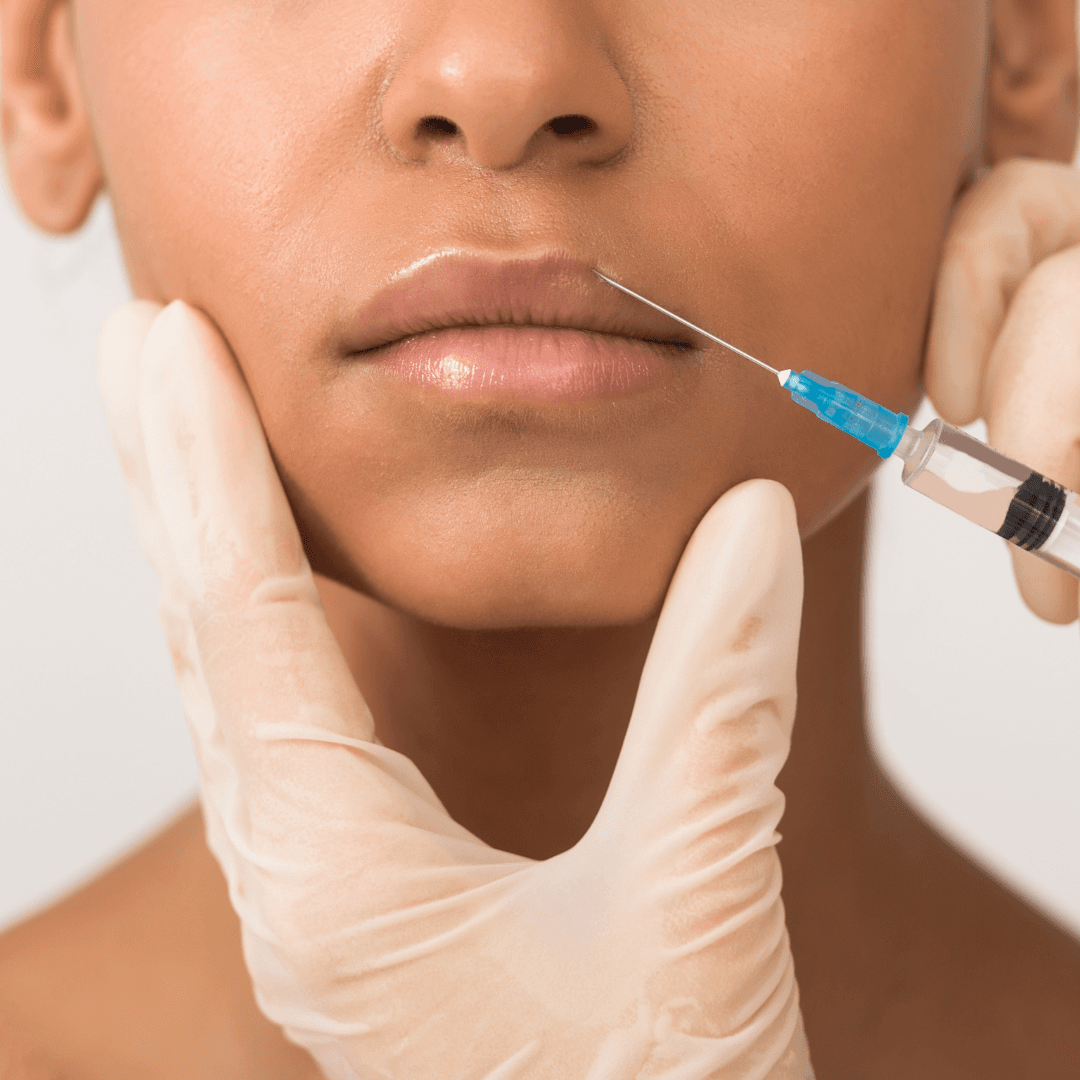
Why Lip Filler Migrates (And Why Some of It Can't Be Undone)
The upper lip starts pointing outward instead of forward — clients describe it as a “duck bill.” There’s puffiness sitting above the lip line where nobody injected anything. Under the eyes, the tear trough area gets a small firm lump that wasn’t there at the two-month mark but is there now. In every one of these cases, the product didn’t stay where it was placed. It moved into the surrounding tissue, and now it’s sitting somewhere it was never supposed to be.
If that’s why you’re here, you’re not imagining it and you’re not being dramatic. That’s migration, in plain terms: filler spreading beyond the original injection site, usually months after the appointment, usually somewhere more visible than where it started. The question that actually matters is what caused it, and whether it can be fixed — and the honest answer depends entirely on which product is sitting under your skin.
It’s a placement problem, not a product problem
Here’s the part that gets glossed over on almost every page you’ll find about this: migration is not usually about a bad batch of filler or a product that’s “prone to moving.” It’s almost always about two things — overfilling, and injecting at the wrong depth or in the wrong tissue plane. Push too much volume into a small, mobile area, or place it too superficially, and the product has nowhere to go but out. It follows the path of least resistance, which in the lips and under the eyes is almost never the path you want.
This is why the injector matters more than the brand on the box. Two injectors using the exact same syringe of the exact same product can produce completely different results. One places conservatively, respects the anatomy, and stops before the tissue is under tension. The other overfills to make the first visit look dramatic, and six months later the client is Googling “why did my lip filler migrate.” Juvederm and Restylane are both well-established product families — Juvederm’s Ultra Plus XC and Voluma XC, Restylane’s Kysse and Lyft, all of it — and every one of those products can still migrate if it’s placed wrong. The syringe isn’t the variable. The hands are.
If it’s HA filler, there’s an undo button — sort of
If what moved is a hyaluronic acid filler — anything from the Juvederm family (Ultra Plus XC, Voluma XC, Volbella XC, Vollure XC) or the Restylane family (Kysse, Lyft, Refyne, Defyne, Silk) — there’s a real option on the table. Hyaluronidase is an enzyme that breaks down hyaluronic acid, and a licensed provider can use it to soften or dissolve filler that’s ended up somewhere it shouldn’t be.
We’re not going to tell you it’s a guaranteed one-visit fix, because it isn’t. Whether hyaluronidase is the right call, how much tissue is actually affected, and how the area responds once the enzyme goes to work — that’s something a licensed provider has to evaluate in person, not something you can diagnose from a mirror or a symptom checklist. Some cases resolve cleanly. Some need a second look. What we can tell you is that HA filler has a reversal option at all, which puts it in a different category from everything else on this list.
If it’s not HA filler, there’s no undo button
Sculptra, Radiesse, and Bellafill are not hyaluronic acid products, and that one fact changes everything about how migration with them gets handled. Sculptra is poly-L-lactic acid. Radiesse is calcium hydroxylapatite. Bellafill is PMMA — a permanent filler by design. None of these break down with hyaluronidase, because hyaluronidase only works on hyaluronic acid. If one of these migrates, there’s no enzyme injection that reverses it the way there is for Juvederm or Restylane.
That’s not a reason to avoid these products — they exist because they do things HA fillers don’t, particularly for collagen stimulation and long-term volume. But it’s a reason the stakes on placement are higher from the start. With an HA filler, a placement mistake has a corrective path. With Sculptra, Radiesse, or Bellafill, getting the technique right the first time isn’t a nice-to-have. It’s the only real safeguard you get.
Why we check in at two weeks
This is also why we don’t treat the appointment as finished the moment you walk out the door. We offer a two-week follow-up check-in on injectables specifically because early signs of migration or overfilling are far easier to address than a fully settled problem months later. At two weeks, if something’s sitting slightly off — a little more product than intended on one side, early puffiness in a spot that shouldn’t have any — it’s a small, manageable adjustment. At six months, after the tissue has fully settled and the client has been living with it, it’s a bigger correction, and if it’s a non-HA product, potentially not correctable at all.
A follow-up isn’t a courtesy call. It’s a structural checkpoint built around the fact that migration is easier to catch early than to fix late, and that’s true regardless of which filler was used.
Restraint is the actual prevention
If there’s one operating principle that prevents most of this before it starts, it’s restraint. Overfilling is the number-one reason filler looks bad or ends up migrating — not the product, not the client’s anatomy, not bad luck. A conservative first treatment is always easier to build on and adjust than an overfilled one is to walk back. You can always add more filler at a follow-up visit. You cannot always take it back out, especially once it’s moved.
That’s the same philosophy behind not running upsells or pushing an “unlimited plan” on laser services — treating less and reassessing beats going big on the first visit and hoping it settles well. With injectables, where overcorrection is the actual mechanism behind migration, that principle isn’t just good business practice. It’s the difference between a client who comes back for a touch-up and a client who comes back to get something dissolved.
Who’s actually allowed to inject this
Florida law requires that filler be injected by a licensed medical professional — an MD, an ARNP, a PA, or an RN working under physician supervision. That’s not a formality. It’s the line between someone trained to assess your anatomy, recognize the wrong depth or plane before it becomes a problem, and someone who’s just been shown where to push the plunger.
This is exactly why a $299 filler deal should make you cautious rather than excited. At that price point, something usually gives — counterfeit or diluted product, or an injector without the training to recognize when they’re placing too superficially or too much volume in too small a space. Migration risk doesn’t come from bad luck. It comes from exactly those conditions. If you want to see how we approach injectables — including the products we actually use and how we think about placement — that’s covered in detail here.
Location
Manhattan Laser Spa — Sunny Isles Beach, FL